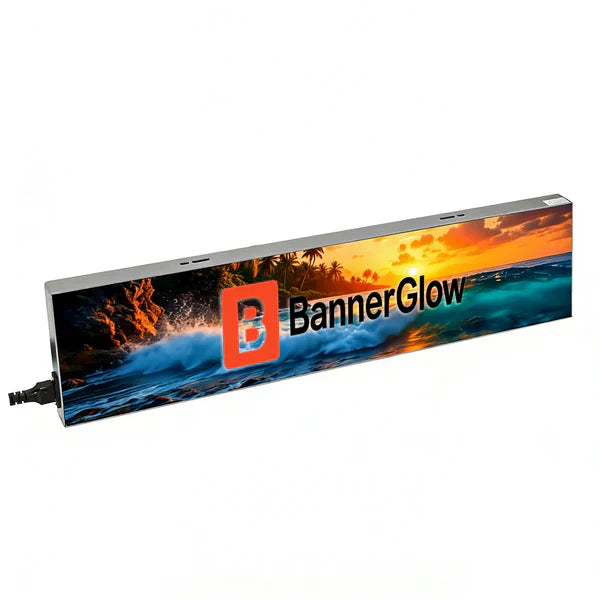
Article: Why Ultra-Thin LED Displays Are Better Suited for Retail Spaces

Why Ultra-Thin LED Displays Are Better Suited for Retail Spaces
When selecting display solutions for retail environments, factors like resolution and size often take center stage. However, one aspect that significantly influences both installation and visual integration is thickness. Ultra-thin LED displays are increasingly being adopted in retail settings precisely because they address this often-overlooked factor.
Their advantages extend beyond aesthetics, impacting how displays interact with space, structure, and user experience.
The design logic behind ultra-thin structures
Traditional display systems typically require internal space to accommodate power units, control systems, and heat dissipation components. As a result, they tend to have a noticeable depth, making them appear as add-on elements rather than integrated features.
Ultra-thin LED displays are engineered with a more compact internal architecture. By optimizing component layout and improving thermal management, manufacturers are able to significantly reduce thickness without compromising functionality.
This allows the display to sit much closer to walls or glass surfaces, visually becoming part of the structure rather than an external device.
Why thinner displays work better in storefront environments
Retail windows and interior walls often need to balance multiple functions, including product presentation, lighting, and spatial openness. A bulky display can interfere with this balance by occupying valuable visual and physical space.
Ultra-thin LED displays minimize this impact. Because they can be mounted closely against surfaces, they preserve the openness of the environment while still delivering dynamic content.
This is particularly beneficial for brands that prioritize clean layouts and layered visual storytelling, where every element must coexist harmoniously.
How reduced thickness changes installation approaches
A thinner display naturally leads to simpler installation methods. Traditional systems often require mounting brackets, structural reinforcements, or pre-built frames, which can complicate deployment.
Ultra-thin LED panels, in contrast, can often be mounted directly onto walls or glass with minimal supporting structure. This not only reduces installation time but also lowers the barrier for integrating digital displays into existing spaces.
In scenarios such as pop-up stores or temporary retail setups, this flexibility can be especially valuable.
Does thinner mean weaker performance?
It’s reasonable to question whether reducing thickness affects performance. However, modern LED engineering ensures that structural refinement does not equate to reduced capability.
Ultra-thin LED displays are designed to maintain consistent brightness, clarity, and operational stability. Advances in materials and circuitry allow these systems to perform reliably even in compact formats.
As a result, “thinness” should be understood as an efficiency improvement rather than a compromise.
To better visualize how different sizes adapt to real spaces
Looking at specific configurations can help illustrate how ultra-thin displays function in various retail environments:
|
Examples for comparing ultra-thin LED display configurations |
Conclusion
In modern retail design, display solutions are expected to do more than simply present information — they must also integrate seamlessly into the environment. Ultra-thin LED displays achieve this by reducing physical presence while maintaining visual effectiveness.
This balance between form and function makes them an increasingly practical choice for brands looking to enhance their spaces without overwhelming them.