How LED Sphere Displays Achieve Seamless 360° Visuals
At first glance, an LED sphere display may appear to be simply a curved version of a conventional screen. However, it involves far more complex engineering. Unlike flat panels, achieving a continuous, seamless image across a spherical surface requires precise structural design and specialized content processing. This combination of hardware and software optimization is what sets sphere displays apart as advanced LED technology.
The goal is to allow viewers to see a coherent visual experience from any angle, which requires precision both in the physical construction of the sphere and in how content is mapped onto it.
Structural challenges of building a perfect sphere
Flat LED screens use rectangular modules that fit together easily. Spherical screens, however, must accommodate continuous curvature, which standard modules cannot naturally achieve. Each module must be custom-designed or adapted to align perfectly with the sphere’s surface.
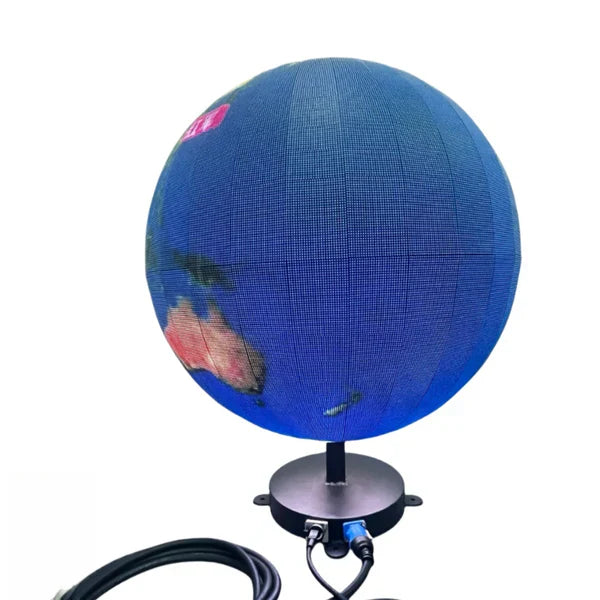
In manufacturing, spheres are divided into multiple curved segments that are meticulously assembled. Even a small misalignment can disrupt the continuity of the displayed content, so high-precision engineering is crucial.
How seamless visuals are achieved
Hardware alone is not enough. Content must be transformed from flat video or images into a format compatible with a spherical display. Specialized mapping algorithms convert two-dimensional content into spherical coordinates, ensuring that visuals wrap around the entire surface without distortion.
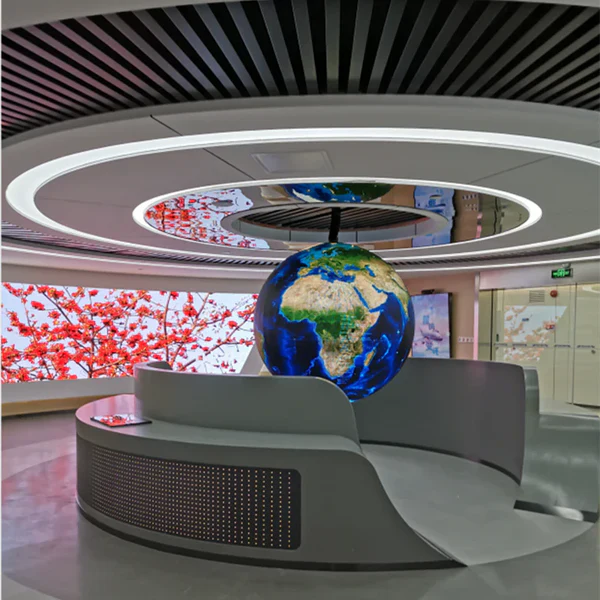
The result is a smooth, uninterrupted image that remains consistent from any viewing angle, creating a true 360° visual experience.
Pixel pitch and viewing quality
Pixel pitch directly impacts image clarity, especially on a sphere where audiences may view from multiple angles and distances. Smaller pixel pitch enables higher resolution, ensuring fine detail is preserved across the curved surface. This is particularly important in close-range environments, such as retail displays or interactive installations. Selecting the appropriate pixel pitch is critical for maintaining image consistency and immersion.
Structural stability and installation
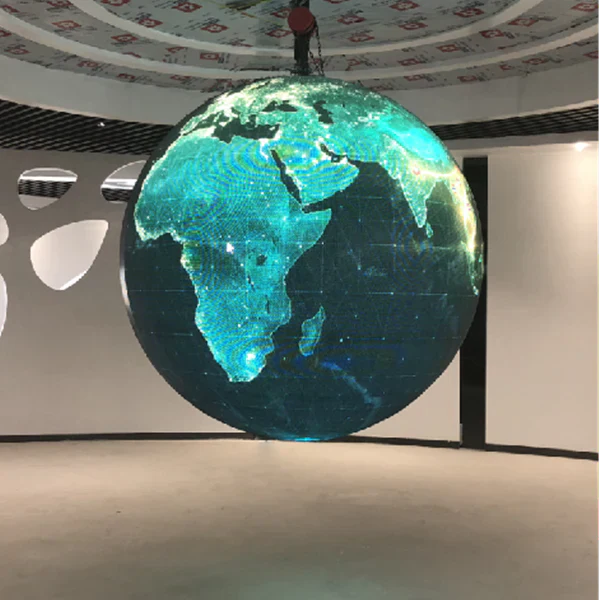
Despite its complex shape, sphere displays are designed to remain stable and safe. Internal support structures provide rigidity while minimizing weight, allowing installation flexibility. Small spheres can be placed on stands or tables, while larger spheres may be suspended or integrated into architectural elements.
Explore configurations and sizes
|
Application |
Product (Click to View) |
|
High-resolution close-range display |
|
|
Balanced medium display |
|
|
Large-scale installation |
Conclusion
The LED sphere display achieves immersive visuals through the integration of advanced structural engineering and sophisticated content mapping. By overcoming the limitations of flat screens, it provides viewers with a continuous, engaging, and fully three-dimensional visual experience.