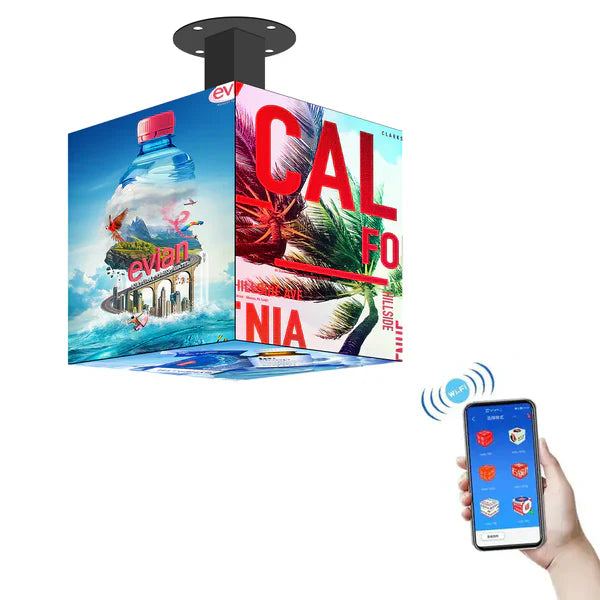
Article: Why Cube‑Shaped LED Displays Are Redefining Multi‑angle Visual Experiences
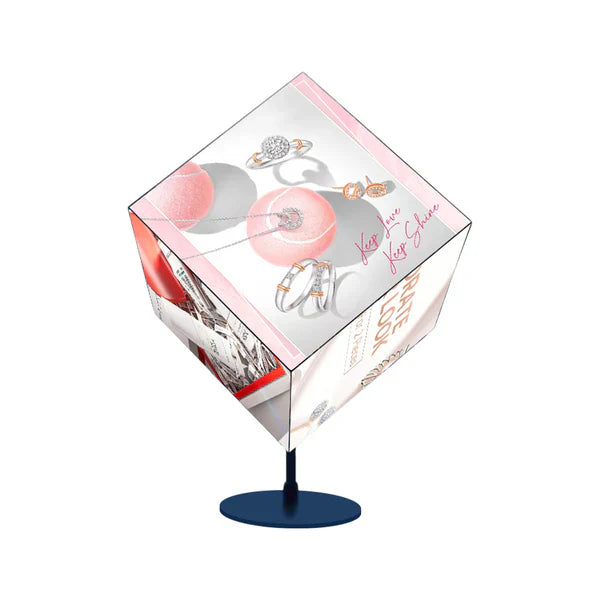
Why Cube‑Shaped LED Displays Are Redefining Multi‑angle Visual Experiences
In the world of digital signage, most displays have historically been flat, rectangular panels mounted on walls or frames. These flat screens deliver content in a single direction—straight on—and are constrained by fixed viewing angles. While such displays have become commonplace in retail and exhibition environments, their visual impact is limited by their lack of dimensionality. Cube‑shaped LED displays, on the other hand, break free from these limitations by arranging vibrant digital content on multiple faces simultaneously. This enables audiences to engage with visuals from nearly any direction, creating a more dynamic and memorable visual experience.
When you enter a space dominated by cube displays, the first thing you notice isn’t just the bright digital content, but the way that content occupies space. Instead of a single flat surface, you’re surrounded by visuals that wrap around edges and faces. This spatial immersion is what gives cube LED displays their unique power—they do not simply display content; they transform it into an architectural element that interacts with space and movement.
Multi‑face structure enhances visual dynamics
Cube LED displays achieve something that flat screens never could: multiple surfaces that present synchronized or independent content. Each face can act as a separate canvas, showing different messages, promotional visuals, or complementary parts of a larger animation. For example, in a trade show booth, the front face might display a product demo video while the side faces show customer testimonials or dynamic branding elements. The result is a 360‑degree broadcast that invites viewers to circulate around the display rather than stand in front of it.
Because each face operates independently yet can be synchronized, content designers have far more freedom. They can create narrative flow that wraps around the cube, telling richer stories that unfold as viewers explore the display from different angles. This multi‑dimension storytelling increases engagement time and makes the content more memorable.
How cube LED displays outperform flat screens in space
A large flat screen certainly attracts attention, but it does so from a fixed perspective—mostly frontal. In contrast, cube LED displays engage viewers from every side. In high‑traffic areas, such as shopping malls or corporate atriums, cube displays are effective because they address people moving in different directions. A shopper walking by might catch a compelling headline on one face, while someone approaching from the opposite side sees product imagery or brand visuals. This simultaneous visibility from multiple directions fundamentally changes how information is consumed in public and commercial environments.
Furthermore, cube LED displays serve dual roles: they act as both digital content platforms and sculptural objects. Instead of feeling like a “screen stuck in a space,” they become part of the architectural language of the environment, reinforcing both brand identity and spatial character.
Choosing size and pixel pitch for visual impact
The physical dimensions of a cube LED display significantly influence how it performs in a given environment. Smaller cube displays, such as those built with 320 × 320 mm faces, function effectively in intimate spaces—think boutique storefronts, reception desks, or experiential zones within larger exhibits. These compact cubes deliver high‑quality visuals without overwhelming the immediate space, making them ideal for close‑up viewing where pixel detail matters.
As cube size increases, however, the display’s role shifts. Larger cubes—such as 640 × 640 mm or 750 × 750 mm models—are better suited for exhibition halls, large retail spaces, and open lobbies. These configurations provide a larger digital canvas, allowing for more complex animations, videos, and multi‑face storytelling sequences that make a bold visual statement at greater distances. Additionally, pixel pitch plays an essential role: tighter pitches (smaller mm values) yield finer detail for close viewing, while broader pitches still deliver compelling visuals at moderate or long distances with smoother content transitions.
Recommended cube LED display solutions
|
Recommended Direction |
Product (Click to View) |
|
Compact tables & window displays |
|
|
Immersive mid‑sized exhibit displays |
6‑Face 640×640 mm Inclined Floor Standing Cube LED Display (P2.5) |
|
Outdoor event & large spaces |
Conclusion
Cube‑shaped LED displays are redefining how digital content interacts with physical space. By breaking away from flat surfaces and leveraging multi‑face digital canvases, they offer a richer, more immersive experience that enhances both content delivery and spatial design. Whether used in retail, exhibitions, or experiential installations, cube LED displays elevate visual engagement by making content part of the actual environment rather than just something that sits within it.