
Article: How to Use 3D Holographic Fans to Create Eye-Catching Displays for Retail Stores and Businesses
How to Use 3D Holographic Fans to Create Eye-Catching Displays for Retail Stores and Businesses
1. Why Are More Businesses Choosing 3D Holographic Fans?
In today's competitive retail and commercial display environments, attracting customer attention is an important part of building brand visibility. Whether it is a retail store, shopping mall, restaurant, or brand showroom, traditional posters and standard digital screens can display product information, but their visual presentation has become increasingly familiar.
3D Holographic Fans offer a different way to present advertising content. Using rapidly rotating LED blades, these devices create floating, holographic-style visual effects that make product images, brand logos, and promotional videos appear to float in the air.
This distinctive display format helps businesses highlight products and create more noticeable brand presentations. For retailers looking to improve storefront displays, promote new products, or create distinctive commercial spaces, 3D holographic fans are a digital display solution worth considering.
Unlike conventional fixed display screens, 3D holographic fans are available in different designs, including flat, cylindrical, and spherical configurations, allowing businesses to choose products according to their available space and display requirements.
2. Where Can 3D Holographic Fans Be Used in Commercial Environments?
3D holographic fans are not limited to large commercial display projects. Different product sizes and structures can serve a variety of everyday business environments.
2.1 Retail Stores and Storefront Windows
For clothing stores, electronics retailers, beauty shops, and specialty stores, storefront windows and entrance areas are important locations for attracting potential customers.
Businesses can use 3D holographic fans to display product animations, brand logos, and promotional videos, adding dynamic visual elements to otherwise conventional window displays.
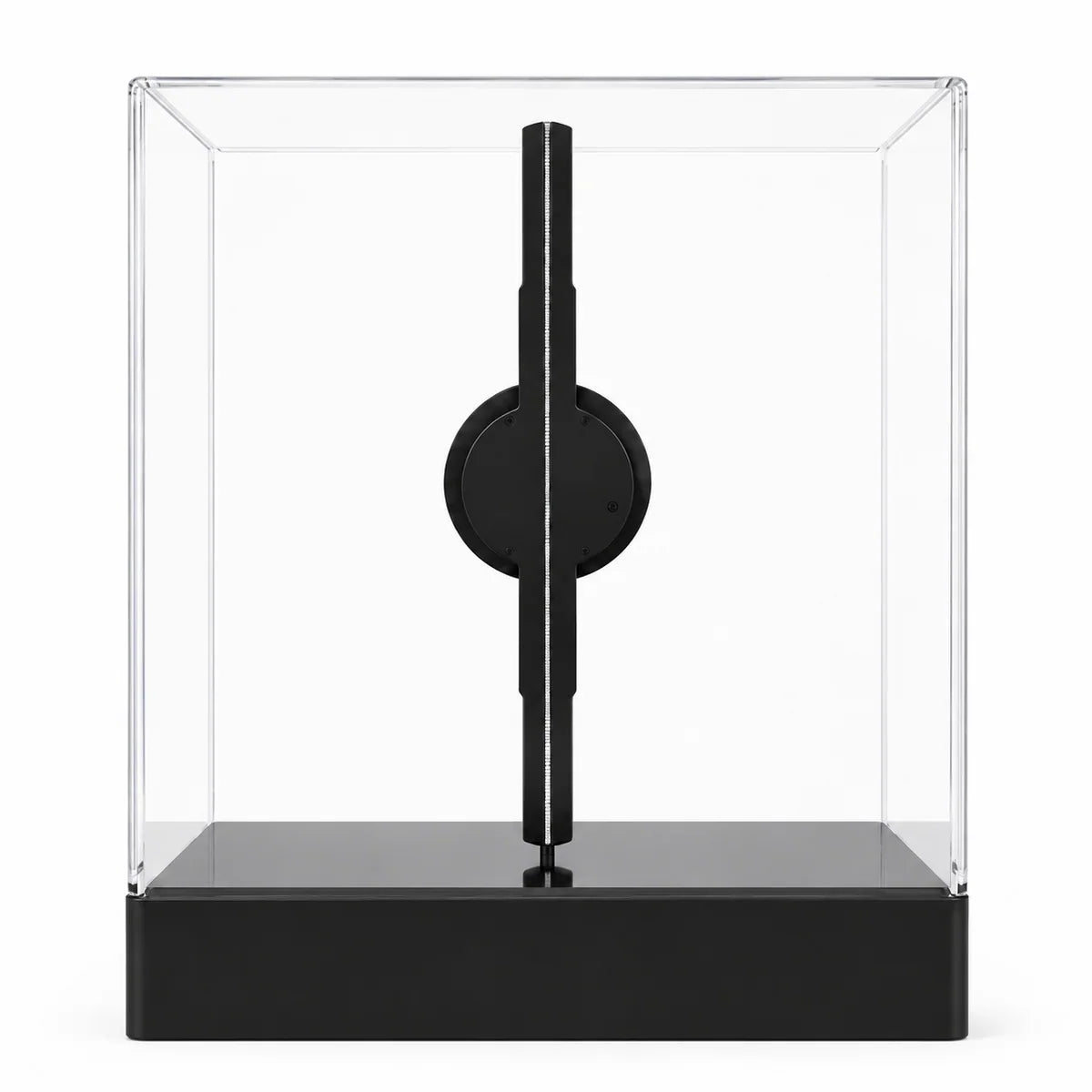
Small models are suitable for counters, shelves, and product presentation areas, while medium-sized units can be positioned near store entrances or in dedicated display spaces. For businesses with limited space, models with transparent protective covers may also provide a more complete display configuration.
2.2 Restaurants, Cafes, and Entertainment Venues
Restaurants and cafes increasingly focus not only on their products and services but also on the overall atmosphere and brand identity of their spaces.
3D holographic fans can be used to display menus, signature beverages, brand logos, and promotional content. For example, cafes can showcase animated beverage presentations, restaurants can promote signature dishes, and bars or entertainment venues can use dynamic visuals to create a more distinctive atmosphere.
For businesses that want content to be visible from multiple directions, cylindrical or spherical display models may be worth considering. These designs provide an alternative visual presentation for shared indoor spaces.
2.3 Trade Shows, Events, and Brand Promotions
At trade shows and commercial events, brands often need to stand out within limited display spaces.
3D holographic fans can be placed near booth entrances, display counters, or promotional areas to present product animations, brand logos, and promotional videos.
Medium-sized flat models are often easier to position in standard exhibition booths. Businesses looking to create a more distinctive display area can also consider cylindrical or spherical models.
Event organizers can update the displayed content according to different campaign themes, allowing the same equipment to support multiple brand promotion activities.
2.4 Product Showrooms and Brand Experience Spaces
For businesses that display multiple products, 3D holographic fans can complement traditional display cabinets and digital screens.
Companies can use these devices to present product animations, brand introductions, and promotional videos, helping visitors explore products through dynamic visual content.
If a showroom requires viewing from multiple directions, cylindrical and spherical holographic displays are also worth considering. They offer a different visual presentation from conventional flat displays.
2.5 Shopping Malls and Public Display Areas
Shopping malls, flagship stores, and large commercial spaces often provide multiple opportunities for digital advertising and brand presentations.
Medium-sized devices can be used in brand display areas, while large and extra-large models may be considered for more spacious environments.
For locations that require visual content to be viewed from multiple directions, cylindrical and spherical displays can also be considered, providing an alternative to conventional flat-screen presentations.
3. What Are the Different Types of 3D Holographic Fans?
When choosing a 3D holographic fan, businesses should consider not only the display size but also the overall product structure and viewing experience.
BG offers different display configurations designed to meet a range of requirements, from standard retail displays to creative commercial spaces.
3.1 Flat Holographic Fans
Flat holographic fans are the most common type of 3D holographic display. They use rotating LED blades to create floating visual images.
They are suitable for displaying brand logos, product images, promotional advertisements, and dynamic videos. Depending on their size, they can be used on counters, in retail stores, showrooms, and commercial event spaces.
For businesses using 3D holographic displays for the first time, flat models are generally a straightforward product option to understand and select.
3.2 Cylindrical Holographic Fans
Cylindrical holographic fans use multiple display units arranged in a cylindrical structure to create a 360-degree visual presentation.
Compared with standard flat models, they emphasize multi-directional viewing and are suitable for locations where visitors can view the display from different angles.
For example, brand experience centers, shopping malls, and creative exhibition spaces can use cylindrical displays to present dynamic brand content and product visuals.
3.3 Spherical Holographic Fans
Spherical holographic fans use a spherical display arrangement to create panoramic visual presentations.
These products are suitable for spaces where display design and visual differentiation are important, including flagship stores, exhibition venues, digital art displays, and specialty commercial events.
For businesses looking to create a distinctive visual feature within their commercial spaces, spherical displays provide an alternative to standard flat display equipment.
4. How to Choose the Right 3D Holographic Fan for Your Business
Different businesses have different display spaces and requirements. Choosing the right equipment involves considering product size, viewing distance, placement, and the type of content being displayed.
Small models are more suitable for counters, desktops, and close-range product presentations. Medium-sized devices can be used near store entrances, in retail promotions, and in general commercial display areas. Large models are more suitable for shopping malls, exhibitions, and spacious brand presentation areas.
If the goal is to present content from multiple directions, cylindrical or spherical products may be more appropriate than focusing only on the size of a flat holographic fan.
Before purchasing, businesses should identify the intended installation location, primary viewing directions, and display content requirements. These factors help determine which product configuration is most suitable for the available space.
5. Choose the Right Control Method for Easier Content Management
In addition to product structure, the control method is another important factor when selecting a 3D holographic fan.
The BG collection includes products featuring three main control approaches: asynchronous control, synchronous control, and cloud control. Each serves different usage requirements.
5.1 Asynchronous Control
Asynchronous control generally uses local device storage to play uploaded content. Once the content has been transferred, the device can play it according to its supported playback settings without requiring a continuous network connection during playback.
This method is suitable for retail stores, product counters, reception areas, and regular advertising displays.
For businesses that only need to update promotional images or videos periodically, asynchronous control offers a relatively straightforward content management solution.
5.2 Synchronous Control
Synchronous control allows a device to display content in real time from a connected computer or media source.
It is suitable for product launches, live demonstrations, trade shows, and events where display content needs to change in coordination with presentations.
For example, event organizers can coordinate the displayed visuals with live demonstrations, making the holographic fan part of the overall event presentation.
5.3 Cloud Control
Cloud control uses a cloud platform to manage and distribute content remotely. Depending on the supported platform, functions may include remote content updates, playback scheduling, and centralized management of multiple devices.
For businesses operating multiple stores or display locations, cloud control can help organize promotional content across different locations.
For example, retail chains can update advertising materials according to individual store campaigns without having to visit every device to make changes.
Cloud-controlled products generally require a network connection for remote management. Specific operating requirements should be confirmed for the selected model and control platform.
6. How to Improve the Display Performance of 3D Holographic Fans
Choosing the right device is only the first step. Content design and equipment placement also influence the overall display experience.
First, advertising content should have a clear visual focus. Brand logos, product images, and promotional animations should remain recognizable. Avoid placing too many complicated elements in one composition, allowing customers to understand the displayed message quickly.
Second, consider viewing distance and ambient lighting. Devices placed near counters are generally viewed at closer distances, while displays in shopping malls and larger commercial spaces need to be evaluated for visibility from farther away.
Third, select the display location according to the product structure. Flat models are suitable for designated viewing areas, while cylindrical and spherical models may be better suited to open spaces with multiple viewing directions.
Finally, businesses can prepare different promotional materials for seasonal campaigns, new product launches, and special events. This allows the same device to support different marketing activities over time.
7. What Should You Consider Before Buying a 3D Holographic Fan?
For retailers, small businesses, and commercial display buyers, several factors should be considered before making a purchasing decision.
-
Application: Will the device be used in a storefront, on a counter, in a restaurant, at a trade show, or in a brand showroom?
-
Display Structure: Should you choose a standard flat model, a cylindrical display, or a spherical display?
-
Display Size: How much installation space is available, and from what distance will customers typically view the display?
-
Protective Configuration: Do you need a transparent protective cover, housing, or additional accessories?
-
Control Method: Do you require local content playback, real-time computer synchronization, or remote cloud management?
-
Content Requirements: Will the device mainly display logos, product images, or promotional videos?
-
Installation Method: Do you need desktop stands, floor stands, or ceiling-mount accessories?
Defining these requirements in advance can help businesses avoid unnecessary product selection mistakes and find equipment that better matches their actual usage needs.
8. 3D Holographic Fan Selection Guide for Different Business Applications
To help businesses identify suitable product configurations more easily, the following table summarizes common commercial applications and recommended product directions.
| Business Application | Main Display Objectives | Recommended Product Type | Suggested Size or Structure | Key Purchasing Considerations |
|---|---|---|---|---|
| Retail Counters and Small Stores | Product presentations, brand logos, promotional content | FL-S Small Flat Models | 11–42cm | Available space, close-range viewing, protective covers |
| Store Entrances and Window Displays | Product promotion, brand advertising | FL-M Medium Flat Models | 45–64cm | Display area, viewing angles, installation position |
| Restaurants and Cafes | Menu presentations, beverage promotions, brand content | FL-S and FL-M | Small to medium | Counter space, placement, content updates |
| Trade Shows and Commercial Events | Product animations, brand displays, event promotions | FL-M and FL-L | Medium to large | Equipment layout, stands, playback methods |
| Large Retail Stores and Flagship Stores | Large product presentations, brand promotion | FL-L and FL-XL | Large and extra-large | Viewing distance, available space, installation requirements |
| Brand Experience Centers and Creative Exhibitions | Multi-directional viewing, immersive visual presentations | CYL-M and SPH-M | Cylindrical and spherical | Display location, viewing directions, overall space |
Note: These are preliminary application and selection recommendations, not fixed model specifications. Final product selection should be based on actual product specifications, installation conditions, and available configurations.
9. Choose the Right 3D Holographic Fan for Your Store or Commercial Space
Whether you want to improve storefront displays, strengthen the brand image of a restaurant or cafe, or add distinctive visual content to exhibitions and commercial events, 3D holographic fans offer an alternative to traditional flat-screen displays.
From compact desktop devices to large flat displays, as well as cylindrical and spherical configurations, different products can accommodate a variety of spaces and presentation requirements.
When choosing a product, it is not always necessary to prioritize the largest size or the most complex structure. What matters most is selecting equipment that matches your business environment, display content, and customer viewing experience.
Explore our 3D Holographic Fan collection to discover display products suitable for your store, brand, or commercial space.
Explore Our 3D Holographic Fan Collection
If you are unsure which structure, size, or control method is right for your business, consider your store type, installation location, and display requirements when comparing available products.

